

A Guide To Nissan Spark Plugs: All You Need To Know
Nissan owners - let's talk about one of the smallest, but most important, parts in your engine: the spark plug.
It might not look like much, but this little guy is the hero that makes your engine roar to life. There's one located in each cylinder, firing thousands of times per minute to turn air and fuel into smooth, reliable power.
But like any hard-working part, spark plugs don't last forever. When they start to wear out, they can cause all sorts of headaches.
You've asked us a lot of questions about spark plugs, so we're combining all our knowledge into one ultimate guide. We'll cover what they do, when to replace them, where to find the best replacements, and OEM vs. aftermarket Nissan spark plugs. Let's get started.
What Do Spark Plugs Do?
In simple terms, the spark plug's job is to ignite the mixture of air and fuel inside your engine's cylinders.
- Your car's electrical system sends a high-voltage charge to the plug.
- That charge jumps across a tiny gap at the end of the plug, creating a precisely-timed spark.
- That spark ignites the air-fuel mixture, causing a small, controlled explosion.
- That explosion pushes the piston down, which turns the crankshaft, which ultimately makes your wheels spin.
This happens over and over, thousands of times a minute, in perfect harmony. When your plugs are healthy, your engine starts easily, idles smoothly, and burns fuel efficiently. When they're not, you'll start to notice.
Telltale Signs Your Spark Plugs Are Failing
Your Nissan is pretty good at telling you when something's wrong. If you're experiencing any of these symptoms, your spark plugs are the first place to check.
1. Rough Idle: You know that smooth, steady hum your engine makes at a stoplight? A bad spark plug can turn that into a shaky, rough, or jittery vibration.
2. Trouble Starting: If your car takes a long time to start (or just cranks and cranks without "catching"), it could be because the spark plugs aren't strong enough to get the combustion process going.
3. Engine Hesitation or Misfiring: If you feel a stumble or jerk when you step on the gas, that's likely an engine misfire, meaning a cylinder isn't firing correctly - a classic sign of a worn-out plug.
4. Worse Fuel Economy: Are you suddenly visiting the gas station more often? Failing spark plugs can't burn the fuel mixture efficiently, meaning your engine uses more gas to do the same amount of work.
5. Poor Acceleration: If your car feels sluggish and just doesn't have that get up and go it used to, it's because you're not getting full power from each cylinder.
6. The Check Engine Light: This light can mean a lot of things, but a misfire caused by a bad spark plug is one of the most common reasons it'll pop on.
If you're handy, you can check them yourself. A healthy, used plug should have a light grayish-tan deposit. A bad plug might look black and sooty, wet and oily, or have a damaged or eroded electrode.
When Should You Replace Your Nissan's Spark Plugs?
This is the million-dollar question, and the answer has changed a lot over the years.
In older cars, standard copper spark plugs needed to be replaced around 30,000 to 50,000 miles.
However, most modern Nissans come from the factory with long-life platinum or iridium spark plugs. These are made from much harder, more durable materials and are designed to last many more miles under normal driving conditions.
The most important rule: Always check your owner's manual. Your manual will give you the exact service interval for your specific model and engine. That's the schedule you should follow to keep your car in warranty and running perfectly.
The Big Debate: Genuine OEM vs. Aftermarket Plugs
Okay, it's time to replace your plugs. You see a genuine Nissan plug and a cheaper, universal aftermarket plug. They look similar, so what's the big deal?
This is, by far, the most critical decision you'll make. As your official Nissan parts source, we can tell you: this is not the place to cut corners.
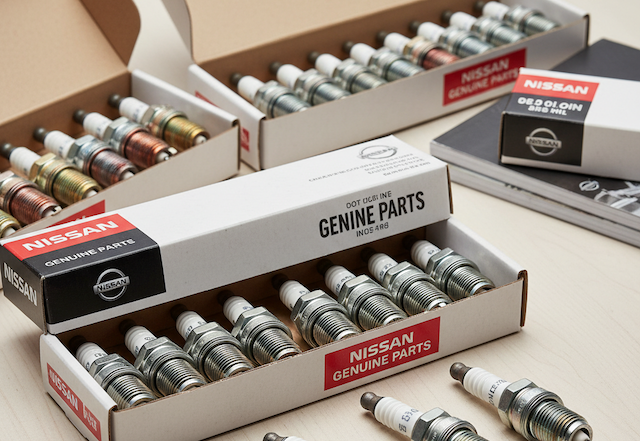
Here’s why genuine OEM (Original Equipment Manufacturer) Nissan spark plugs are the only smart choice.
- Perfect Fitment: An OEM plug is designed exactly for your engine. The length, the thread size, and the heat range are a perfect match. An aftermarket one-size-fits-all plug that's even a millimeter off can cause poor performance, or worse, engine damage.
- Quality Materials: Nissan engineers specify high-grade materials (like that long-life iridium-platinum alloy) for a reason. Aftermarket brands often use lower-grade materials to cut costs, which means they'll wear out faster and perform poorly.
- Correct Resistance: Spark plugs create electrical 'noise.' Your Nissan's sensitive electronics (like the radio and engine computer) are designed to work with the exact resistor built into an OEM plug. A cheap aftermarket plug can cause electrical interference, leading to static on your radio or even confusing your engine's sensors.
- No Guesswork: When you buy OEM, you are getting the right part, full stop. No-cross-referencing, no "will this fit?" - just the part your car was designed to use.
An aftermarket plug might save you a few dollars today, but it can cost you much more down the road in the form of bad fuel economy, failed emissions tests, or even damage to your engine's sensitive components.
Can I Replace A Spark Plug Myself?

For many Nissan owners, the answer is a yes. Changing your spark plugs is one of the most popular and satisfying DIY auto maintenance jobs, and it's a fantastic way to save a good amount of money on labor costs.
The job typically requires a few specific tools - namely a socket wrench, an extension, and a special spark plug socket that's designed to grip the plug safely. The most important things are patience and care, especially when you're threading in the new plugs (you never want to cross-thread them, as that's a very expensive fix).
On many four-cylinder engines, the plugs are right on top and incredibly easy to access. On some V6 or V8 models, the rear plugs can be a bit more of a challenge. Look up a trusted tutorial for your specific Nissan model. If it looks manageable, you can absolutely do this.
How Much Do Nissan Spark Plugs Cost?

The honest answer is: it depends. The price for a single spark plug can range from just a few dollars to upwards of $20 or $30. Why the big difference? It all comes down to the type of plug your Nissan needs.
Older vehicles might use a basic copper or platinum plug, which are on the more affordable end. However, almost all modern Nissans are engineered to use high-performance, long-life iridium spark plugs. These cost more because the material is more durable and provides a much longer service life.
While you might save a couple of bucks on an aftermarket plug, remember that genuine Nissan OEM plugs are the smart investment for guaranteed fit, performance, and longevity.
OEM Nissan Spark Plugs From Nissan Parts Plus
Your spark plugs are the small but mighty heart of your Nissan's engine. They're critical for performance, reliability, and fuel economy. Don't compromise on such a vital component.
When it's time for a replacement, give your Nissan the genuine parts it deserves.
At NissanPartsPlus.com, we have the factory-spec, genuine OEM Nissan spark plugs your car was built for. Shop our full selection of spark plugs today and keep your engine running like new!